

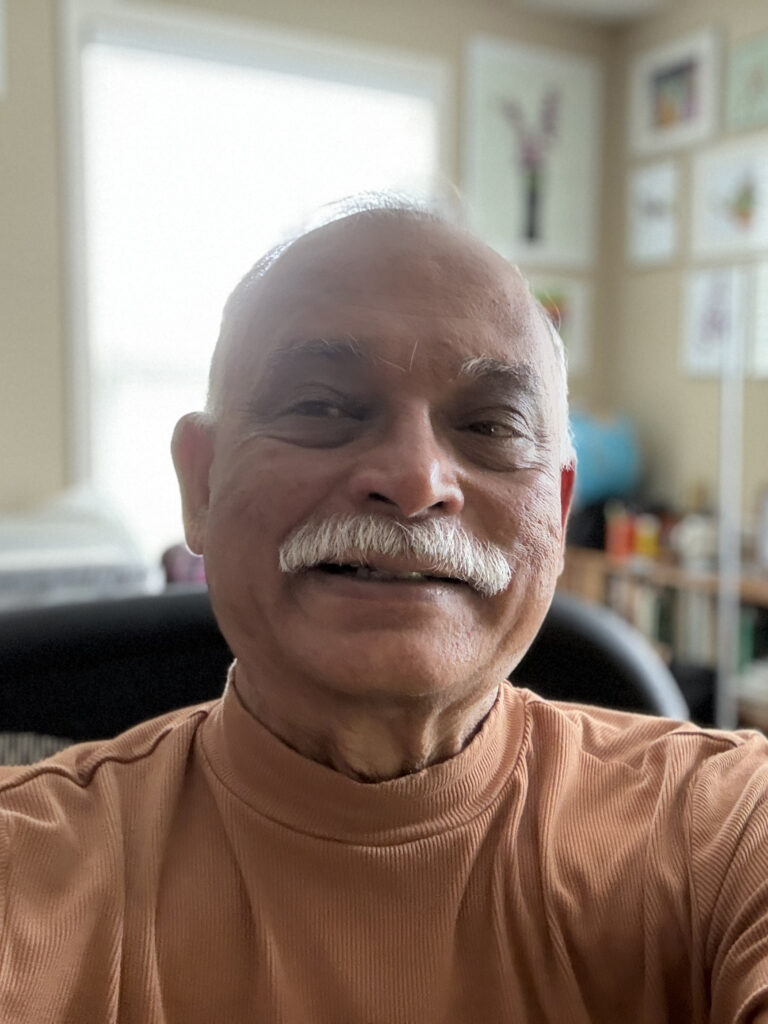
Q: How long have you been a member, and why did you join RoCo?
A: I think it is about 4 years. Art is my second act after my first folded when I retired several years ago. I was looking for a place that promoted contemporary art in Rochester. So here I am.
Q: What is your favorite exhibition that you’ve seen at RoCo?
A: I would say my most emotional experience at RoCo was the exhibition of works by R G Miller: “Tsi Non:we Entewaha’hara’ne / Our Path Forward”. I thought the scars of colonialism were only part of the South American continent. On the Art side, I always enjoy the unlimited diversity of art during the annual members exhibition.
Q: Can you tell us a bit about your background as a mechanical engineer and how that has influenced the artwork you create now?
A: I was an engineering academic until my retirement. My practice involved teaching and research in mechanical and aerospace engineering, mathematics, and computer programming. The connection to art happened through my fortuitous use of Bézier curves for solving engineering and mathematical problems. I started to take notice of the prettiness of the curves. Very soon I started exploring these curves to create free and abstract forms. These curves form a large part of most of my works. Now, I create mathematically defined contemporary artworks. They include decorative designs, geometric abstracts, and contemporary landscapes. I have no formal training in art but I have always admired painting and sculpture.
Q: When creating your art, do you focus more on the process or the end result?
A: I have to focus on both. I do not physically draw or paint, instead, I write code that instructs the computer to place the dots, draw the lines and curves, create the patches, and add the color. The curves, areas, and volumes are defined through mathematics and they bring my vision to the screen. This appears to be a new, original way to create visual art. I enjoy doing it and almost often viewers are surprised and enjoy it too. This unique approach allows me to explore the possibilities of mathematical definition, precision, scaling, placement, structure, or its lack of, resulting in artworks that are clean, crisp, colorful, and captivating. I am continuously learning, experimenting, evolving, and advancing my creativity. I am wonderfully surprised by how the work turns out in the end and look forward to what the future will bring in.
Q: What do you need to take the next step with your artwork?
A: My work celebrates the beauty of dots, lines, curves, forms, and color. They are nothing more than that! They are free from the traditional constraints of representation and color. There is no manual. I learn by trial and error. I am always looking to expand my range of presentations. My landscapes only happened a year ago. This year I am looking to incorporate 3D into 2D to make the works bold and more captivating.
Q: What’s one skill you think everyone should learn, no matter their career?
A: I believe everyone should find the time, however little, to explore, develop, be creative, and continuously engage in an interesting hobby that does not involve their profession. This is a great escape mechanism that provides relief from normal stress and anxiety. It is a simple and very direct way to meditate.
Q: Now something totally different - what’s your ideal way to spend a completely free day?
A: Sitting on the deck, under the shade, watching the world go by while admiring the flowers, the colors, the variety, the shapes, and all the actions in nature under my nose. Of course accompanied by time appropriate beverages like cold beer or bourbon.